Tuesday, April 30, 2013

Poseidon: Earth Shaker


Poseidon, brother of Zeus, son of Kronos and Rhea, ruler of the seas and creator of storms, tempests, and tsunamis that shake the earth, is back in live action and color thanks to George O'Connor and First Second Books. This book has breath-taking art, great story-telling, a detailed Greek god family tree to help us mere mortals follow their royal lineage, Greek Geek notes, discussion points, and links for extra reading. Aside from O'Connor's continuing to bring the Greek Gods to life rivaling  D'Aulaire's Book of Greek Myth's mantle, this book belongs in home and school libraries.  Let's take a closer look why:

This fifth volume of the Olympian series is absolutely AWESOME as George O'Connor tells his story through a powerful combination of image and text story-telling.  In telling Poseidon's story, O'Connor focuses on a few themes, all of which serve as vehicles for further discussion and learning, and all of which can be used in integrating Common Core State Standards:
  • Throughout the book Poseidon questions his "choice" to rule the seas and whether it was a choice at all.  Was Zeus' idea to draw lots the best way to divide the cosmos? This, in turn, can lead to discussions for readers of all ages about decisions and decision making, and whether our decisions are as 'free' as we think they are. For example, on pages 4-7 O'Connor relays how Zeus and his brothers divided the spoils of the battle of the Titans.  He notes that, "Zeus was awarded the sky. He alone of us grew up knowing it...there could be no other way...I of course, drew the sea. As with my brothers, this was the only way it could be... Or was it?"
Poseidon: Earth Shaker by George O'Connor Image courtesy of First Second
  • O'Connor also relays Poseidon's role in  Odysseus' story from Poseidon's perspective.  As a result this book can be used for classroom or independent reading on Greek mythology as well as a preview for Homer's Iliad and Odyssey, and James Joyce's Ulysses. This is also a way to introduce 1st-person versus 3rd-person narratives and the value of perspective (complying and integrating Common Core State Standards).
Poseidon Earth Shaker by George O'Connor  image courtesy of First Second Books

  • To introduce Poseidon's son Theseus, O'Connor relays Poseidon's regret that "my children have always tended to be monstrous (Polyphemos the cyclops, Triton, Otus and Ephialtes, to name a few), and his reflection (on page 26) that "The desire to produce a suitable heir drives so much of what we do." This theme is found throughout history and literature and can be used, for example, when discussing the lengths Henry VIII took to have a son or  Shakespeare's King Lear's quest to find the right child to inherit his kingdom(to name a few).  This clearly fits the new Common Core State Standards integrating literature, non-fiction and history with multi-modal story telling. This can also be used as a writing theme (creative or analytic) on parenting roles and perspectives.

Poseidon: Earth Shaker by George O'Connor image courtesy of First Second Books
  • Visual literacy -relates to our ability to use and understand images to tell emotional, meaningful and memorable stories. This is especially evident in the vivid images and story O'Connor presents as Poseidon wrestles with his 'choice' of being god of the seas.  As Poseidon gently falls to the bottom of his realm, for example, he begins to wrestle with this 'choice.' While he feels the seas aptly reflects his temper and moods, his tempestuous nature builds as "the waves slide from my dark hair...from the roaring deep my voice thunders...I am Poseidon, earth shaker, ruler of the boundless sea, creator of storms, swallower of ships." This building of emotion is done brilliantly through the use of image and page/panel design and begs deeper analysis. O'Connor's portrayal of Thesues' role in mastering the labyringh and slaying the minotaur is also a classic example of how image can tell a story.  Here are some discussion points to consider when critically reading and evaluating any portion of this book:
    • Point out the use of color, lines and shading to build the story around the text
    • Discuss how emotions are relayed in the images (especially in pages 5-12)
    • Discuss the use of panel arrangement to help tell the story.  On pages 37-42 O'Connor tells the story of Theseus and the Labyrinth.  Here in particular O'Connor playfully uses panels to help tell the story.
      Poseidon: Earth Shaker by George O'Connor image courtesy of First Second Books


Thank  you for your visit.  
Please leave your reactions and other teaching point in the comments.

And, please check out the links below for more on Poseidon.


More links for Poseidon and for Poseiden Earth Shaker by Geroge O'Connor, First Second Books:


Monday, April 29, 2013

What are Perceptual Motor Skills, And How do I Help my Kid Get Them? Part II

harlemglobetrotters.com
In an earlier post, "What are Perceptual Motor Skills and How Do I Get my Kid Some?" I gave an overview of what perceptual motor skills are, how they impact daily in our lives, and how to help promote them.
Perceptual motor skills refer to our ability to coordinate constant input and feedback between our eyes - brain - and muscles as we plan, coordinate and effectively carry out specific activities such as moving, walking, running, skipping, eating, working, writing, keyboarding, texting, driving, playing, etc.
I've gotten a lot of wonderful inquiries and feedback (thank you all), and devote this post to discussing the differences between gross motor skills, fine motor skills, and  grapho-motor skills - which correspond to different muscle groups and therefore to different types of perceptual motor skills, all of which we rely daily from birth to death.

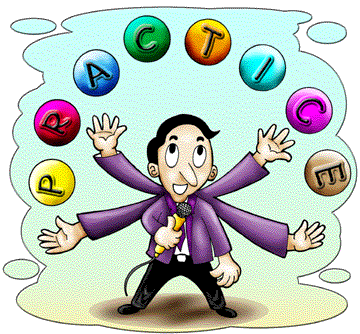
Our development of perceptual motor skills begins at birth, and while there are developmental milestones doctors, psychologists, health providers and teachers will refer to, kids develop these skills at different rates.  IF you are concerned about your own child's skills, ask these professionals for guidance.  However, the best way to develop these skills is to practice them and consciously pay attention to the feedback you get when practicing.  Feedback refers to how successful each element of the practice was at achieving the target goal- the strength used, the grip used, the extension used, etc.

http://www.greatvoice.com/images/practice-1_01.gif
From: www.greatvoice.com
How to help kids develop perceptual motor skills: Different activities engage different types of muscle groups and as a result different muscles and brain centers are responsible for coordinating eye-brain-hand/foot/mouth/body responses.  
  • ALL percpetual motor skills develop at slightly different paces although experts have set 'normal' developmental milestone limits, and 
  • ALL development involves practice in use and recognizing and understanding motor feedback (how effective different movements are at achieving a target goal).

From: blog.virtualworldfitness.net

FINE MOTOR SKILLS involve coordinating the use of small muscle groups (typically in the fingers, hands, wrists, feet, toes, lips and tongue)  in tasks such as buttoning, sewing, eating, beading, painting, drawing, tying shoe laces, or grabbing something with your thumb and forefinger. Note that fine motor skills, while integrating eye-brain-hand feedback, are not responsible for handwriting (which falls under graph-motor skills - more details below).

What you can do to help kids develop fine motor skills:
  • PRACTICE, practice, practice.  Start with simplified, large materials and gradually move to smaller/heavier/narrower objects.
  • Play with legos and blocks- starting with the larger pieces and gradually integrate and move to the smaller ones;
  • Beading - start with large beads and once mastered, bead with smaller and smaller objects;
  • Bow tying - you may want to start with thick yarn or thick tying materials on dolls, large books and gradually move to thinner and thinner tying materials such as laces.
  • Make play-dough together, mixing the flour, water, salt, by hand and choosing your own colors.  Making it requires kneading which is EXCELLENT fine motor practice for all kinds of hands.
  • For younger kids, there are wonderful fine-motor books you can make or buy where you can read the book and have your child practice buttoning, tying, sewing, playing with zippers, etc. These are great because the practice element is built in and is fun!
  • For kids with weak oral/mouth/tongue coordination, practice making sounds placing the tongue in different locations. Note the difference sounds depending on the placement of tongue and lips.
  • Squeezing squeezy toys can help kids develop stronger grips and hand muscles.

 For more information on fine motor skills please read:

GROSS MOTOR SKILLS involve coordinating the use of large muscle groups involved in motor activities that involve large movements such as crawling, walking, running, jumping, balancing, dancing, most sports.

What you can do to help kids develop gross motor skills:
  • PRACTICE, practice, practice.  Start with simplified, large materials and gradually move to smaller/heavier/narrower objects. Also, for those with weak gross motor skills, have them practice in the privacy of their home/room where they won't fall victim to possible ridicule and/or embarrassment.
  • Play ball, practice throwing and catching.  Start with large, soft balls and gradually decrease their size and weight
  • Teach your child how to skip which involves stepping and hopping.  Break down the skipping movements and exaggerate them at first, refining the movements gradually.
  • Practice balance by walking on wide lines or tiles and gradually trying to walk on narrower lines.
  • Play games like Simon Says and Mother May I

 For more information on gross motor skills please read:

GRAPHOMOTOR SKILLS involve highly specialized coordination between eye-hand-finger movements used for writing, and writing only. [Drawing, interestingly enough falls under fine-motor skills.] More specifically, graphomotor skills include how to effectively hold a pencil so the hand doesn't tire, muscle movements needed to shape letters, and kinesthetic feedback necessary to monitor progress when writing making sure the letters look like they're supposed to, that the ink or pencil lead is not too weak or too strong, and that there is just the right space between letters and words so others can read them (whether they are in print or script).

What you can do to help kids develop graphomotor skills:
  • PRACTICE, practice, practice. 
  • Have your child practice handwriting - first with a large pencil and large lined paper, gradually using thinner pencils and more narrowly spaced lines.
  • Grips help some kids but not all of them.  Furthermore, there are different types of grips and you may want to experiment.
  • Make sure students have enough space on math sheets and worksheets to comfortably fill in the required response.
 For more information on graphomotor skills please read:


Thank you all so much for your visit.  Please leave your thoughts, ideas and perceptual motor strategies in the comments below.

Monday, April 22, 2013

Optical Illusions and their role in Education, Brain Training, and Visual Literacy

Aside from being fun, optical illusions actually play a role in education and in visual literacy.  They help illustrate that we see by learning to see.  While our brains relay information taken in through our eyes, we learn to interpret what we see by recognizing and storing patterns we learn as we continuously interact with the world around us.  These patterns enable us to identify faces, dangers, friends, directions, routes, and opportunities around us.

[SPOILER ALERT:  This post will detail how we learn to see and illustrate the power of optical illusions...but if you don't have time for all of it, skip to the final video clip which will blow your minds - at least it blew mine.]

Understanding Optical Illusions and the Power of Visual Literacy:
When learning to see, read, or interact with the world around us, context is integral to understanding.  Context helps prime the brain to anticipate what is coming, usually making processing faster and more efficient.  We do this all the time with reading.  While research now shows that we 'look at' and process each letter as we read, our brains process the shape evaluating "probable' letters and constructing 'probable' words and content.  This is why it is so important to preview new materials when teaching. When we our brains 'think' it is one letter or word and it doesn't make sense, more attention is given to the visual cues and reading slows down. Context is also essential when viewing/interpreting images and it is context that creators 'twist' with optical illusions.

Here's how CONTEXT helps us learn how to see:
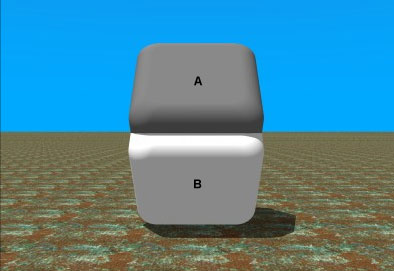
You can take identical squares and surround them in different colors and they will 'look' different. In this example, the surface color of squares A and B are identical.  Cover the seam where squares A and B meet, and you'll see (wait a few seconds for your eyes/brain to adjust).
Identical Colors
From: http://brainden.com/color-illusions.htm
For more on color and the "context" different colors relay, please go to:

But, there's a lot more to context and learning to see than color cues.

Gestalt theory addresses many of these issues formulating that the unified whole of an object we 'see' is more than the sum of its individual parts.  Gestalt theorists originally identified five key principles (and later added a sixth) that influence how we 'see' when we look at images:
    old or young woman?
    From: http://kids.niehs.nih.gov/games/illusions/
  • Figure/Ground - we tend to separate forms in an image, focusing on "dominant wholes" while pushing other parts of the image into the background.  We do this with the optical illusion of the "old hag/young woman" for example.  In this image we can push the old hag's face and white hair forward or place the young woman's brown hair and hat with feather forward pushing the old hag's features in the background. Camouflage works under this principle as well.  The material's meandering lines of mottled-colored patterns disrupt our brains by trying to hide the contour or outline of the body or vehicle.  

From:http://jeffbrew.com/2012/02/26/howto-gestalt-principles-and-photography/
Another very famous example by Edgar Rubin, the "Rubin Vase" is one of the most well know demonstrations of how the figure-ground relationship works:  In this case, the image changes depending on whether we focus on the faces or the vase.
    From: http://gestalttheorysam.blogspot.com/2011/02/6-principles-of-gestalt-theory.html
  • Proximity - we tend to group objects together based on their placement or proximity. So, objects or shapes that are close to one another appear to form groups.  Fruit in a bowl is perceived of as "fruit" and not "one banana, one apple, one apple, grapes, one orange, and one more apple." In the example above, the proximity of dots and dark spots become a 'dog':
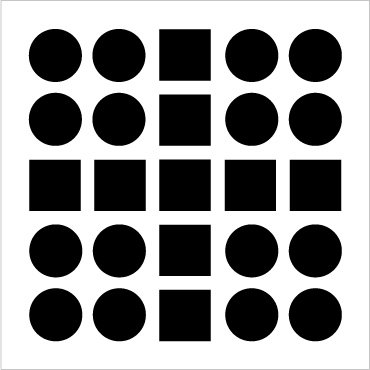
  • Similarity - we tend to perceive forms with similar characteristics (size, color, shape, etc.) as a group. The more alike the items are, the more likely they are to form groups. As dissimilar as they are, our minds will conversely resist grouping them together.  In the image here, there are two different shapes that are grouped to form a pattern. We group the squares together to form a cross surrounded for four groups of circles.  In this case, the square is the figure and the sets of circles are the ground.
  • Closure - we tend to 'fill in' information in images which appear incomplete to us.  We do this when reading or writing (and unfortunately sometimes when editing): we often won't recognize if letters were missing because we tend or prefer to see words as complete entities and not as individual letters. Scott McCloud (Understanding Comics) discusses how our brains automatically want to make shapes into human (or recognizable) forms.  In the image here, we see the swirls of 'people' as a tree because our minds focus more on the continuous 'movement' of the people, and close them into one complete image
  • Continuance or Continuity- we tend to continue shapes beyond their ending point as the edge of one shape will continue into the space and meet up with other shapes or edges of the picture plane. Continuance in the form of a line, an edge, or a direction from one form to another creates a fluid connection among compositional parts. Here are three factors that contribute to continuance: 
    • Perspective
    •  Eye direction of a subject - if an object in a photo or image is looking in a particular direction,  our eyes will follow the gaze of that subject;
    •  Paths or rivers draw effectively use 'line' to draw the viewer's eyes in a particular direction. 
In the image of the 'tree' above, continuance is involved as the images of 'swirling' continue into each other to create the tree.  Perspective and continuance work brilliantly in this photograph found at http://jeffbrew.com/2012/02/26/howto-gestalt-principles-and-photography/. In this photograph, the causeway forms a line of continuity, drawing the viewer's eyes to the group of trees in the background.
  • Some have added a sixth principle of Symmetry - when we perceive objects we tend to perceive them as symmetrical shapes that form around their center. Furthermore, the principle of symmetry work particularly well when framing photos and images. People are accustomed to receiving information in a systematic and organized manner and tend to avoid material that requires too much work to process and comprehend.  A symmetrical design will create a sense of equilibrium and balance while an asymmetrical design will cause tension. Often, however (especially with images), the tension created makes the image more interesting and less 'boring'(see the photo below).  The goal is to structure you images (and your text) to be easy to follow but not overly predictable and engaging with some nuance, twist, or hook to keep your audiences attention.
From: http://jeffbrew.com/2012/02/26/howto-gestalt-principles-and-photography/


NOTE that while I have given you visual examples of each of the gestalt principles, many images use multiple principles to successfully work as optical illusions.

For fun, here is a link of optical illusions in photos from Bored Panda with some of my favorites below:

 1. Camouflage art by Wilma Hurskaninen (link)


2. French landscape astrophotographer Laurent Laveder shows how some simple props and a bit of imagination can turn the moon into anything you like. (link)


3. A work by Japanese artist Makoto Aida titled AZEMICHI (a path between rice fields). (link) which clearly illustrates the principle of continuance.


The artist Maurits Cornelis Escher is famous for his optical illusions which integrate most of the gestalt princiiples:

Relativity, 1953

 Drawing Hands, 1948


But there is even more to learning to see than gestalt and color... some images become so familiar and universal, they become symbols or icons. Just the way we learn to use the alphabet and sight words to help us read, we use icons, signs and symbols to help us see. A car's dashboard, for example will show an icon to tell us to change the oil, close our doors, secure our seat belts, when we need gas (and on what side of the car we will find the gas tank) and so much more:


From: depositphotos.com


Playing with optical illusions provides us with experience in learning HOW to interpret complex images.  The more we experience, the more flexible we are in interpreting what we see.


A rabbit, looking right? Or a duck, looking left?
From: http://kids.niehs.nih.gov/games/illusions/

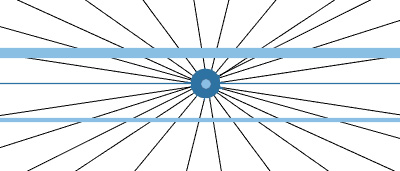
The Hering illusion is an optical illusion discovered by the German physiologist Ewald Hering in 1861. The two horizontal lines are both straight, but they look as if they were bowed outwards. The distortion is produced by the lined pattern on the background that simulates a perspective design, and creates a false impression of depth. Note that the thinner line appears more bowed than the thicker line.
Hering illusion


In closing, here is a literally 'mind-blowing' video illustrating HOW are minds are trained to interpret images a certain way, and how confusing it is for us when we 'see' one thing but our mind 'understands' what we see in another way entirely.  Below is a video that the mind (at least my addled mind) just can't grasp - illustrating how important the 'literacy' segment is of visual literacy

For more fun, brain blasting and brain training please visit these cites:
Thanks for your visit this week.  Please leave your favorite optical illusions or any other reactions, suggestions, and/or questions in the "Comments."
 

Sunday, April 14, 2013

Neuromania, Neuromyths and Neuroscience

By EKTA from http://www.nytimes.com/2012/11/25
In the early 1990's a new neuro-imaging technique called "positron emission tomography" (PET) utilizing radioactive tracers was used  to study what areas of the brain were activated for various speech/cognitive exercises. These studies, however seemed to report conflicting data or data that could not be accurately replicated.

A few years later, PET was replaced with a more flexible technique of functional magnetic resonance (fMRI), allowing scientists to study people's brains without the risk of using radioactive tracers. Subsequent studies produced more standardized methods of analyzing brain activity, yielding more consistent results.

And, as a result neuroscience went public... 'everyone' was interpreting and these studies, publishing books on brain activity and how we think.  As a result educators, neuro-scientists, physicians and others began to question the authenticity such publications. Alissa Quart in a blunt New York Times op-ed (November 23, 2012) spoke out applauding "neurodoubters" who like neuroscience but don't like "what her or she considers its bastardization by glib, sometimes ill-informed popularizers." According to Quart:

Such journalism, these critics contend, is... nothing more than "simplified pop."...As a journalist and cultural critic, I applaud the backlash against what is sometimes called brain pron, which raises important questions about this reductionist, sloppy thinking and our willingness to accept seemingly neuroscientific explanations for, well, nearly everything.
A team of British scientists recently analyzed nearly 3,000 neuroscientific articles published in the British press between 2000 and 2010 and found that the media
regularly distorts and embellishes the findings of scientific studies...The problem isn’t solely that self-appointed scientists often jump to faulty conclusions about neuroscience. It’s also that they are part of a larger cultural tendency, in which neuroscientific explanations eclipse historical, political, economic, literary and journalistic interpretations of experience.
This "neuro-porn" is fueled, in part, by most of us who just want to 'understand' our minds: how we think, how we learn, why we do things the way we do them, and/or why some things seem easy to us and other things seem so challenging.
The Growing Brain - Interactive Graphic - NYTimes.com | Mind, Brain, and Teaching | Scoop.it
From: http://www.scoop.it/t/mind-brain-and-teaching

Part of the problem with neuroscience, according to Gary Marcus in a New Yorker online article Neuroscience Fiction (December 2, 2012) is that,
"...a lot of those reports are based on a false premise: that neural tissue that lights up most in the brain is the only tissue involved in some cognitive function...Most of the interesting things that the brain does involve many different pieces of tissue working together...we may need new methods, like optogenetics or automated, robotically guided tools for studying individual neurons...The real problem with neuroscience today isn’t with the science—though plenty of methodological challenges still remain—it’s with the expectations. The brain is an incredibly complex ensemble, with billions of neurons coming into—and out of—play at any given moment. 
In an engaging post by Sharpbrains, Do You Believe these Neuromyths, 32 "brain-related" statements are posted based on a study by Sanne Dekker, Nikki Lee, Paul Howard-Jones and Jelle Jolle Neu­romyths in edu­ca­tion: Preva­lence and pre­dic­tors of mis­con­cep­tions among teach­ers (Frontiers in Educational Psychology, 18, October 2012) along with how well educators distinguished myth from fact.

Here are a sample of Dekker et.al "brain-related" statements (along with a few others taken from other sources listed below in the "read more' section).  How informed are you?

From: http://ecologyofeducation.net/wsite/?p=4086#


Myth or Fact:   
  1. We use our brains 24 h a day.
  2. Chil­dren must acquire their native lan­guage before a sec­ond lan­guage is learned. If they do not do so nei­ther lan­guage will be fully acquired.
  3. It has been sci­en­tif­i­cally proven that fatty acid sup­ple­ments (omega-3 and omega-6) have a pos­i­tive effect on aca­d­e­mic achieve­ment.
  4. When a brain region is dam­aged other parts of the brain can take up its func­tion.
  5. We only use 10% of our brain.
  6. The left and right hemi­sphere of the brain always work together.
  7. Dif­fer­ences in hemi­spheric dom­i­nance (left brain, right brain) can help explain indi­vid­ual dif­fer­ences amongst learn­ers.
  8. The brains of boys and girls develop at the same rate.
  9. Brain devel­op­ment has fin­ished by the time chil­dren reach sec­ondary school.
  10. Infor­ma­tion is stored in the brain in a net­work of cells dis­trib­uted through­out the brain.
  11. Learn­ing is not due to the addi­tion of new cells to the brain.
  12. Indi­vid­u­als learn bet­ter when they receive infor­ma­tion in their pre­ferred learn­ing style (e.g., audi­tory, visual, kinesthetic).
  13. Learn­ing occurs through mod­i­fi­ca­tion of the brains’ neural con­nec­tions.
  14. Nor­mal devel­op­ment of the human brain involves the birth and death of brain cells.
  15. Men­tal capac­ity is hered­i­tary and can­not be changed by the envi­ron­ment or expe­ri­ence.
  16. Vig­or­ous exer­cise can improve men­tal func­tion.
  17. Envi­ron­ments that are rich in stim­u­lus improve the brains of preschool chil­dren.
  18. Cir­ca­dian rhythms (“body-clock”) shift dur­ing ado­les­cence, caus­ing pupils to be tired dur­ing the first lessons of the school day.
  19. Reg­u­lar drink­ing of caf­feinated drinks reduces alert­ness.
  20. Extended rehearsal of some men­tal processes can change the shape and struc­ture of some parts of the brain.
  21. Indi­vid­ual learn­ers show pref­er­ences for the mode in which they receive infor­ma­tion (e.g., visual, audi­tory, kines­thetic).
  22. Learn­ing prob­lems asso­ci­ated with devel­op­men­tal dif­fer­ences in brain func­tion can­not be reme­di­ated by edu­ca­tion.
  23. Pro­duc­tion of new con­nec­tions in the brain can con­tinue into old age.
  24. There are sen­si­tive peri­ods in child­hood when it’s eas­ier to learn things.
  25. Left-handed people are organized, right-brained people are creative.
Want to see how teach­ers in the UK and Nether­lands per­formed? Click HERE


Here are the answers to Myth (I- Incorrect) or Fact (C- Correct):
1 (C), 2 (I), 3 (I), 4 (C), 5 (I), 6 (C), 7(I), 8 (I), 9 (I), 10 (C), 11 (C), 12 (I), 13 (C), 14 (C), 15 (I), 16 (C), 17 (I), 18 (C), 19 (C), 20 (C), 21 (C), 22 (I), 23 (C), 24 (C), 25 (I),


In short, we all have be careful about what we read. This is more true now with access (via the Internet) to vasts amounts of information from so many unknown or unfamiliar sources. When reading about neuropsychology, look at the source and evaluate the research, the science, and experimental design behind the statements you're reading. And when in doubt, ask your physician.


For more on this please read:

Thank you for your time and visit.  
Please share your 'brain-related statement' awareness, your reactions and impressions or your questions in the "Comments" below.

Saturday, April 6, 2013

Math Anxiety: What it is and How to Relieve its Stress and Impact

The title alone is making me nervous and I LIKED math!!  But don't worry.... help is here!

Research shows that the greatest anxiety is experienced anticipating math and not actually doing it. Experts also find that "reframing" the anxiety (much more below) will help.

So, before tackling the mammoth math monster, let's laugh at some math anxiety images, 'reframe' and then deal with the issue.


From: www.krismath.org
From:mbaker.columbiastate.ed
Calvin and Hobbes Math
by Bill Watterson  http://www.gocomics.com/calvinandhobbes/2011/03/09/?utm_term=comics&utm_source=twitterfeed&utm_medium=twitter

RESEARCH:
While the concept of math anxiety is not new, there now studies supporting how 'real' it is and how it creates 'real' neurological responses in the brain.

From:aplusala.org
This past October (10/31/2012) in the UChicago News ("When people worry about math, the brain feels the pain") William Harms  reported on work done by Sian Beilock, (professor of psychology at the University of Chicago and a leading expert on math anxiety) and her student Ian Lyons (postdoctoral scholar at Western University in Ontario, Canada),  noting that:
"...mathematics anxiety can prompt a response in the brain similar to when a person experiences physical pain...
Using brain scans, scholars determined that the brain areas active when highly math-anxious people prepare to do math overlap with the same brain areas that register the threat of bodily harm—and in some cases, physical pain.
Surprisingly, the researchers found it was the anticipation of having to do math, and not actually doing math itself... “The brain activation does not happen during math performance, suggesting that it is not the math itself that hurts; rather the anticipation of math is painful...”
The current work is also consistent with other research from Beilock and Lyons... Beilock’s work, supported by the National Science Foundation and the Department of Education, has also shown that mathematics anxiety can begin as early as first grade, and that female elementary school teachers often transmit their math anxiety to their female students.
This latest study points to the value of seeing math anxiety not just as a proxy for poor math ability, but as an indication there can be a real, negative psychological reaction to the prospect of doing math. 
Rather than simply piling on math homework for students who are anxious about math, students need active help to become more comfortable with the subject, Beilock said. Beilock’s work has shown, for instance, that reframing and writing about math anxieties before a test can reduce one’s worries and lead to better performance.
[Note: Beilock is the author of the best-selling book about stress and performance, Choke: What The Secrets Of The Brain Reveal About Getting It Right When You Have To.]

In an earlier article (Math anxiety causes trouble for students as early as first grade") Harms reported on earlier studies by Beilock which found that,
Worries about math can disrupt working memory, which student could otherwise use to succeed...working memory [is] a kind of 'mental scratchpad' that allows us to 'work' with whatever information is temporarily flowing though consciousness...it's especially important when we have to do a math problem and juggle numbers in our head.
The findings of Beilock, Gerardo Ramirez, Elizabeth Gunderson and Susan Levine - published in the article Math Anxiety, Working Memory and Math Achievement in Early Elementary School, in early preview on the website of the Journal of Cognition and Development, the authors noted that:
"Early math anxiety may lead to a snowball effect that exerts an increasing cost on math achievement by changing students' attitudes and motivational approaches towards math, increasing math avoidance, and ultimately reducing math competence.
Adding hope, however,  the authors noted that:
"Fortunately, there is hope for alleviating the negative impact of math anxiety on math achievement. When anxiety is regulated or reframed, students often see a marked increase in their math performance... One way to reframe anxiety is to have students write about their worries regarding math ahead of time.
The researchers further speculated that for younger students, expressive picture drawing (in place of writing) may help them reframe and more effectively reduce the stress and burdens felt by their anxieties towards math.
From: rationalmathed.blogspot.com

HOW PARENTS AND TEACHERS CAN  HELP RELIEVE MATH ANXIETY
1. Minimize rote memorization by making math meaningful. Here are some suggestions:
  • Play math and counting games with your kids even before they get to school.  This will help them be much more comfortable with numbers and number concepts.
  • When you go shopping, before entering the store give your kids some "spending money" helping learn the value of money while figuring out 'how much' of various items they can afford that trip.
  • Provide real life puzzles involving math such as how to divide an apple, cookie or pie evenly; how early you have to get up if it takes 15 minutes to shower, 10 minutes to get dressed, 15 minutes to grab breakfast, etc.  These 'games' and puzzles help remove the rote memorizing math seems to entail for many, and becomes involving, creative.  For more see this link: How to Make Learning Math Fun
  • Help kids 're-tile' the classroom or playroom floor using different shaped tiles (this can be done when learning about shapes, learning about remainders, geometry, area, etc.)
  • Integrate math with great story-telling by having kids create comics and graphic novels (creating the panels and pages involves 'area', shapes,etc.).
  • Peanuts Cartoon Math
    by Charles Schulz http://www.gocomics.com/peanuts/1966/04/21
  • Build bridges and structures
  • For ratios, proportions, charts and graphing have kids design surveys to ask other classes and then learn to chart the responses - or during political campaigns have them do surveys they can report on.
      Calvin and Hobbes
      By Bill Wateterson http://www.gocomics.com/calvinandhobbes/1985/12/02
TEACHERS: For more on this read Lockhart's Lament where he gives other examples of making math meaningful.
2. Reframe the math anxiety:
  • Parents and teachers might show humorous math-anxiety cartoons, help kids draw their own, talk about the anxiety before approaching new math topics, lessons and math tests.
  • Math Curse  an awesome picture book by Jon Scieszka and Lane Smith is a super way to show how math is everywhere and you don't need to be a math 'wiz' to deal with it.  It is also deals with math anxiety in a creative way and is a great book for math students of all ages.  Here is a YouTube trailer for the book:
  • Talk about math and other anxieties and how they can be overcome. Here is a clip of the"quicksand" scene from The Replacements as Gene Hackman  clearly illustrates 'reframing'.  In this clip the coach is trying to help his players overcome their fears to help them be better players and not freeze like deer in headlights:
     
  • Help kids become more aware of their feelings. Help them recognize when they're getting anxious and try 'calming exercises' (this will clearly mean different things for different kids)  BEFORE math study and math homework.
  • Create a comfortable, empowering place to do math work/homework.
3. Try different teaching modes, lessons and techniques - we don't all learn one way. Many students have trouble with math instruction because the teaching of abstract concepts is done almost exclusively through verbal modes.
  • There are manipulatives and pictures available but workbooks and textbooks are verbally directed.  
  • There are wonderful online computer games that can help reinforce math concepts that are not verbally laden. These games and projects such as bridge- building and other hands-on projects help kids conceptualize important math concepts.
  • Here is a clip of non-verbal math games and instruction that is solely non-verbal - image and visually literate based. It is put out by MIND Research Institute and the presentation is compelling. We are only at the beginning of multi-medial and visually driven learning and MIND research is helping to provide options and multi-modal reinforcement of learning materials.

MIND Research is a company that has developed an impressive array of computer games that illustrate various math principles. 270,000 students as of 8/2020 and close to 1,000 schools in 20 states (as of 8/2010). The key is the instructional software and the interaction of the student with the software. ST Math Fluency uses a visual approach to teach math facts for students to reach an automatic retrieval / performance level.

For additional links, motivational quotes and advice on general test taking please go to Test Taking Tips.

To help kids laugh and minimize their anxiety - below are Calvin and Hobbes links to help (taken from http://www.comicmath.com/comics.html) 
http://www.gocomics.com/calvinandhobbes/1985/12/02 Statistical Analysis and Sample Size
To help kids laugh and minimize their anxiety - below are Peanuts links to help (taken from http://www.comicmath.com/comics.html)
  •  March 6,  1983:  Doing Math in your sleep. I think the only answer that works is Z equals zero but check me on that.  (And you'd get 0/0 so that's not so great)
  • June 9,  1983: An unexpected report card
  • June 25, 1983: Sometimes the only way to gain unique knowledge is to figure it out yourself the long way
  • Nov 15, 1983: Great one for teachers on the importance of wait time
  • Dec 7, 1983 : The terrors of multiplying 9 by 12
  • Dec 9, 1983: On how to estimate the dumb things you've done
  • Dec 13, 1983: More is better! 
Before closing, I want to share one more image with you:
From: teachingcollegemath.com
Clearly, one more way to reduce math anxiety  is to both make students comfortable with numbers and to take the fear of the unknown, particularly the unknown math test out of the equations.  Preparation and previewing can be a huge help.
By Bill Watterson found at http://marco.butte.pagesperso-orange.fr/divertissements/calvinhobbes.html
These are just a few ways of addressing and relieving math anxiety. 
I thank you for your visit and hope you'll share your own math-anxiety experiences and coping mechanisms in the comments.

Tuesday, April 2, 2013

Logos: The Power of Grounding Logic and Expectations in Our Communications

According to Wikipedia, LOGOS was
Greek spelling from Wikipedia
Originally a (Greek) word meaning "a ground," "a plea," "an opinion," "an expectation," "word," "speech," '"account," [and] "reason"...it became a technical term in philosophy, beginning with Heraclitus (535-475 BCE), who used the term for a principle of order and knowledge.
In English, logos is the root of the "-logy" suffix (e.g., geology).
Interestingly, we now use the term "logo" to relate visual or graphic representations of a product, enterprise, organization or slogan -as a means of promoting instant public recognition. Logo is also a multi-paradigm computer programming language designed as a tool for learning.  It is used to develop simulations and to create multimedia presentations.
From what I could find, both modern-day usages of the word incorpororate its earlier meanings - grounding words or images in a certain meaning or using it to create expectations.


With our increased use of short text bursts and visual icons - both modern adaptations of LOGOS are essential elements of communication and learning. In this post, I focus on how Aristotle's use of logos is STILL a vital part of communication used today.  Whether we use logos to relay vital arguments in public speaking,  classrooms, group discussions  - or whether we use it in advertising and politics to convince a target audience of the merits or our "product" - we must learn how to present compelling arguments in a way that seems 'logical,'  familiar  and meaningful to our audiences. This means that not only must we be familiar with our intrinsic arguments, we have to understand which arguments are most effective for any given audience.  NOT an easy feat.  Hopefully the information below will help.

From: logorhythms.blogspot.com


ARISTOTLE'S "LOGOS" AND ART OF RHETORIC: A GUIDELINE FOR CONSTRUCTING AND ANALYZING MEANINGFUL MESSAGES:

Aristotle (in his study of rhetoric) believed that a convincing argument must contain three basic elements: Ethos (incorporating/addressing credibility or 'ethical appeal'), Logos (logic - persuading through the use of reason)  and Pathos (appealing on a personal/emotional level). What makes the study of Aristotle so interesting (at least to me) is that these techniques are still vital for communication today and are routinely incorporated in speeches, printed materials and advertisements.  They are therefore essential for public speaking, advertising, class/work projects, even persuading spouses or kids.  Basically these three components are vital when constructing any verbal or visual message.

In this post I want to focus on logos (future posts will address ethos and pathos). Logos or the logical appeal consists of clearly relating a message and using meaningful examples (facts, data, research, deductive and/or inductive reasoning). The supporting evidence, however, must be information/data your audience can relate to.

Here is a Youtube video showing the use of ethos, logos and pathos in advertising. What is so important for parents and teachers today, is teaching our kids how to 'read' and recognize the persuasive tools (and their use of color, image and text) used in the ads they see and rhetoric they hear all the time that constantly try to persuade them.


For further study, you may want to visit the following sites:

'LOGOS' AND VISUAL LITERACY: BETTER UNDERSTANDING THE MESSAGES BEHIND CORPORATE, POLITICAL AND SOCIAL LOGOS:

Understanding the art of rhetoric and persuasion is important for public speaking as well as for trying to convince a child, parent, friend or spouse to do something. Conversely it is also important for us as consumers to understand that advertisements' images and text are trying to persuade us to do something and are by their very nature biased.  This is where visual literacy comes in.  As our brains process visual images much faster and much more efficiently than text, we need to understand how and why particular images were chosen to persuade us.

A LOT of effort has gone into creating effective company logos. By creating a visual image that relays a particular and distinct message, successful logos clearly relate how a picture is worth a thousand words. Below are only a few examples of the power of successful logos.

In a recent post on color I noted how red has been found to increase heartrate and metabolism and is associated with the feeling of passion and of hunger, while blue is a calming color decreasing heartrate and metabolism, and green is used to relay 'nature' and natural elements.  For more, please see http://departingthetext.blogspot.com/2013/01/color-casts-powerful-messages-learn-how.html


Thinking about color...
Have you noticed that most fast food signs and logos contain red?


Note that Quiznos also contains green which symbolizes nature or earth and wants to convince you of their 'natural' 'healthy' ingredients. Note also how each of these fast food logos contain red - a color proven to raise metabolism and make you hungry while ingraining a particular image of their product - be it their initials, a warm inviting face, or 'protective' structure.


How about Amazon.com's logo:  They're 'good as gold,' they will always leave you with a 'smile,' and you can find all types of products from 'a' to 'z'.


Want more? Have some fun with logos:

LOGOS QUIZ is a popular game for iphone, androids and ipads (and computer adaptations, some of which I have included below) where you have to correctly identify the logos which are presented at different levels of difficulty.. How good are you at identifying these logos... and is that a good thing :-)  ?

In closing, look around, I am sure you can come up with your own awesome examples of effective logos and how they incorporate image, ethos, logos and pathos to convey a particular message.  Please leave your own opinions or favorite effective adds in the comments.

Thanks for your visit, and don't forget to leave your ideas, opinions, suggestions and favorite logos in the comments.